- Home
- Goal Areas
- Career Goals
- Emotional Agility At Work: How to Respond Instead of React
Emotional Agility at Work: How to Respond Instead of React

Workplace stress has a way of pulling you into autopilot. A critical email arrives, a meeting goes sideways, feedback lands harder than expected, and before you have time to think, you've already fired off a reply or shut down entirely.
That gap between the trigger and your behavior is exactly where emotional agility lives. Learning how to respond instead of react during stressful situations isn’t about suppressing what you feel. It's about developing enough self-awareness to choose your next move rather than letting the moment choose it for you.
Research from psychologist Susan David, who coined the term "emotional agility," shows that people who work with their emotions rather than against them report greater well-being and better performance over time. Let’s explore in greater detail how you can improve your emotional agility at work and have better workplace responses.
What Emotional Agility Actually Means
Emotional agility is a skill, not a personality trait. That distinction matters because it means anyone can build it with the right understanding and enough practice.
It's Not About Staying Calm
A common misconception is that emotionally agile people simply keep their cool. They don't. They experience frustration, anxiety, and self-doubt just like everyone else. The difference is that they don't fuse with those emotions or let them dictate behavior.
When you fuse with an emotion, the feeling becomes the entire story. You feel overlooked in a meeting and suddenly conclude you have no influence. You receive critical feedback and decide that you're failing. Agility interrupts that leap.
The science behind this draws from Acceptance and Commitment Therapy (ACT), which emphasizes psychological flexibility: the ability to stay present with uncomfortable thoughts and feelings while still taking action aligned with your values. In workplace terms, that might mean acknowledging that you feel defensive about a piece of feedback before choosing to ask a clarifying question anyway.
The Cost of Reacting on Autopilot
When you react rather than respond, you act from the most immediate emotional signal available to you. Your brain's threat-detection system, the amygdala, fires before your prefrontal cortex has finished processing the situation. The result is behavior you often regret: the sharp reply, the avoidance, the overcommitment made just to ease tension in the room.
Over time, reactive patterns compound. Teams built on reactive communication struggle to surface hard truths because people have learned it isn't safe to do so. Managers who react instead of respond often create cultures of defensiveness without realizing it.
Individual contributors who avoid difficult conversations keep problems alive longer than necessary. The professional cost of reactivity is far higher than most people recognize because it shows up gradually, not all at once.
Building the Pause Between Stimulus and Response
The idea that between stimulus and response there is a space, and that in that space lies our freedom, has become one of the most-cited principles in behavioral psychology. Building that space intentionally is the practical work of emotional agility.
Name What You're Feeling, Specifically
One of the most evidence-backed tools for emotional regulation is affect labeling. Research by Matthew Lieberman at UCLA found that naming an emotion with specificity reduces its intensity by engaging the prefrontal cortex and dampening amygdala activity.
The key word is specificity. "I feel bad" offers your brain very little to work with. "I feel embarrassed because I spoke before I had all the information," gives you something actionable.
Granular emotional vocabulary matters more than most people realize. Psychologist Lisa Feldman Barrett refers to this as emotional granularity, and her research suggests that people with finer distinctions in how they describe their inner states are better equipped to regulate those states.
At work, this means building the habit of asking yourself not just "how do I feel?" but "what, exactly is this feeling, and what does it tell me?" The following emotional checklist can help you pinpoint your exact emotions.
- Anxious vs. uncertain: Anxiety implies threat. Uncertainty implies a gap in information you might be able to fill.
- Frustrated vs. disappointed: Frustration often points to blocked goals. Disappointment points to unmet expectations, which opens a different kind of conversation.
- Angry vs. hurt: Anger tends to externalize. Hurt tends to invite reflection on what you actually need.
- Overwhelmed vs. stretched: Overwhelmed implies no capacity left. Stretched implies you're at an edge, which is often temporary.
-
Defensive vs. cautious: Defensiveness closes down. Caution leaves room for curiosity.
Choosing the right word gives you leverage over the feeling. It also helps you communicate more clearly with others, because vague emotional language produces vague responses.
Create Distance Before You Decide
Cognitive defusion is a technique borrowed from ACT that helps you observe a thought rather than become consumed by it. Instead of thinking "I am overwhelmed," you shift to "I notice I'm having the thought that I'm overwhelmed." It sounds subtle, but the distance that phrasing creates is real and measurable. You go from inside the experience to watching it, which makes a response feel more possible.
At work, this might look like stepping away from a difficult conversation for ten minutes before continuing. It might look like writing your initial reaction privately before deciding whether to send it. Online therapy builds routine and resilience around exactly these kinds of defusion and self-awareness practices, often in ways that carry directly into professional settings.
Practicing Emotional Agility as a Daily Habit
Agility doesn't develop in a single high-stakes moment. It grows through small, repeated choices that gradually shift how you process and respond to the events of your workday.
Respond to the Situation, Not Your Story About It
Every workplace situation arrives with two layers: what actually happened, and the story your brain builds around it. Your colleague didn't respond to your message. That's the event. The story might be that they're ignoring you, that your idea wasn't worth engaging, or that the relationship is in trouble. Acting on the story rather than the situation is where reactive behavior lives.
Emotional agility asks you to separate the two. Getting specific and concrete is a courageous step. You ask yourself what you actually observed, what you genuinely don't know, and what the most grounded interpretation of the situation might be. That process doesn't have to take long. Even a few seconds of deliberate reappraisal can shift the quality of your response.
Make Values-Driven Decisions Under Pressure
When you know what you value most, you have a reference point beyond the emotion of the moment. A person who values honesty can feel anxious about delivering hard news yet still choose to do so. A leader who values respect can feel irritated by a team member's behavior and still respond in a way that upholds their dignity.
This is the difference between an impulsive reaction and an intentional response. The emotion is still there. The values create the direction. Over time, acting from values rather than reactivity becomes easier as neural pathways strengthen with repetition. Each response you choose deliberately is, in a small but real way, retraining the default.
Your Next Move Is Always a Choice
The ability to pause, name what you're feeling, and choose a thoughtful direction is one of the most transferable professional skills you can build. Having emotional agility at work and learning to respond rather than react won't make every difficult moment easier, but it will make you better able to handle them without making them worse.
You don't have to eliminate emotions from your work life. You have to stop letting them drive unchecked. The more you practice the space between stimulus and response, the more that space becomes yours to use as you see fit.
Let's continue the conversation
If you have a question, would like to explore an idea further, or you're wondering how this applies to your life, send me a message using the contact form, or email me directly.
I read every message personally, and I'm always happy to help if I can.
Looking for more goal setting inspiration?
How Career Stress Changes Your Daily Habits
Learn how career stress changes your daily habits when job pressure keeps shaping your routine long after the workday should be over for you.

Affiliated With
Everything on WiseGoals is built on evidence-based psychology and a commitment to helping people flourish. I'm proud to be part of professional organisations that share those values.

Recent Articles


-
What Went Well Exercise: Boost Gratitude & Momentum Step-by-Step
Jan 23, 26 05:33 AM
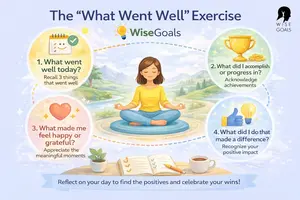 The What Went Well exercise shifts your focus to progress & gratitude. Learn how 5 minutes daily builds momentum!
 -
Everest Goals: How to Set Goals That Truly Inspire You
May 25, 25 11:22 AM
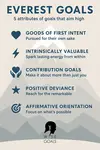 Discover the power of Everest goals—meaningful, energising goals that stretch you and align with your values. Learn how to shift your own goals in this way
 -
Contribution Goals: The Shift That Changes Everything
May 25, 25 11:19 AM
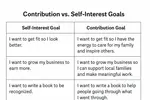 Discover the power of contribution goals and how reframing your goals as contributions can lead to greater motivation, mental wellbeing, and long-term success.